Abschließend noch ein kleiner Blick über den heimischen Tellerrand: Im Anschluss folgt dieser Testbericht erstmals auch in englischer Sprache. Auf eine erneute Einbindung der Bilder verzichte ich dabei bewusst, um den Bericht nicht unnötig in die Länge zu ziehen. Damit möchte ich der zunehmenden Internationalität der Jagd- und Ausrüstungsszene Rechnung tragen und vielleicht gleichzeitig einen kleinen Beitrag dazu leisten, Geartester auch über den deutschsprachigen Raum hinaus noch etwas bekannter zu machen.
Finally, a brief look beyond the domestic horizon: for the first time, an English-language version follows this test report. I deliberately chose not to include the images again to keep the report from getting unnecessarily long. In doing so, I want to acknowledge the increasing international nature of the hunting and equipment scene and, at the same time, make a small contribution toward making Geartester a little better known beyond the German-speaking world as well.
Preliminary Remarks
Zentron provided me with the M6 Pro thermal imaging monocular for testing. I tested the M6 Pro for six months. Regardless, the following remarks reflect my personal impressions and experiences. I did not coordinate this report with Zentron. I also have no business relationship related to this review.
Zentron as a Manufacturer
Zentron has been on the market for quite some time, but so far it has remained something of a shadowy presence in Germany and Europe. Initially, the products were distributed here exclusively by the adapter and suppressor manufacturer EP Arms; Seven Oaks has since taken over distribution. In the USA, by contrast, Zentron already enjoys a considerably higher level of brand recognition than some thermal imaging manufacturers that have long since established themselves firmly on the European market. A look at social media gives a fairly good impression of this. Instagram in particular features numerous videos from American hunting practice in which Zentron devices are used for the popular local pastime of hog hunting. The brand was also correspondingly present at the SHOT Show in Las Vegas, underlining just how important the US market has now become for the manufacturer.
Background to the Test
Since I had already been able to test the Zentron ZEN C50 thermal clip-on device (see the Geartester report dated 31 March 2025) and subsequently even bought one privately in order to build the lightest possible stalking setup around it (see the Geartester Report of the Month dated 11 October 2025), Zentron was of course no longer unfamiliar territory for me.
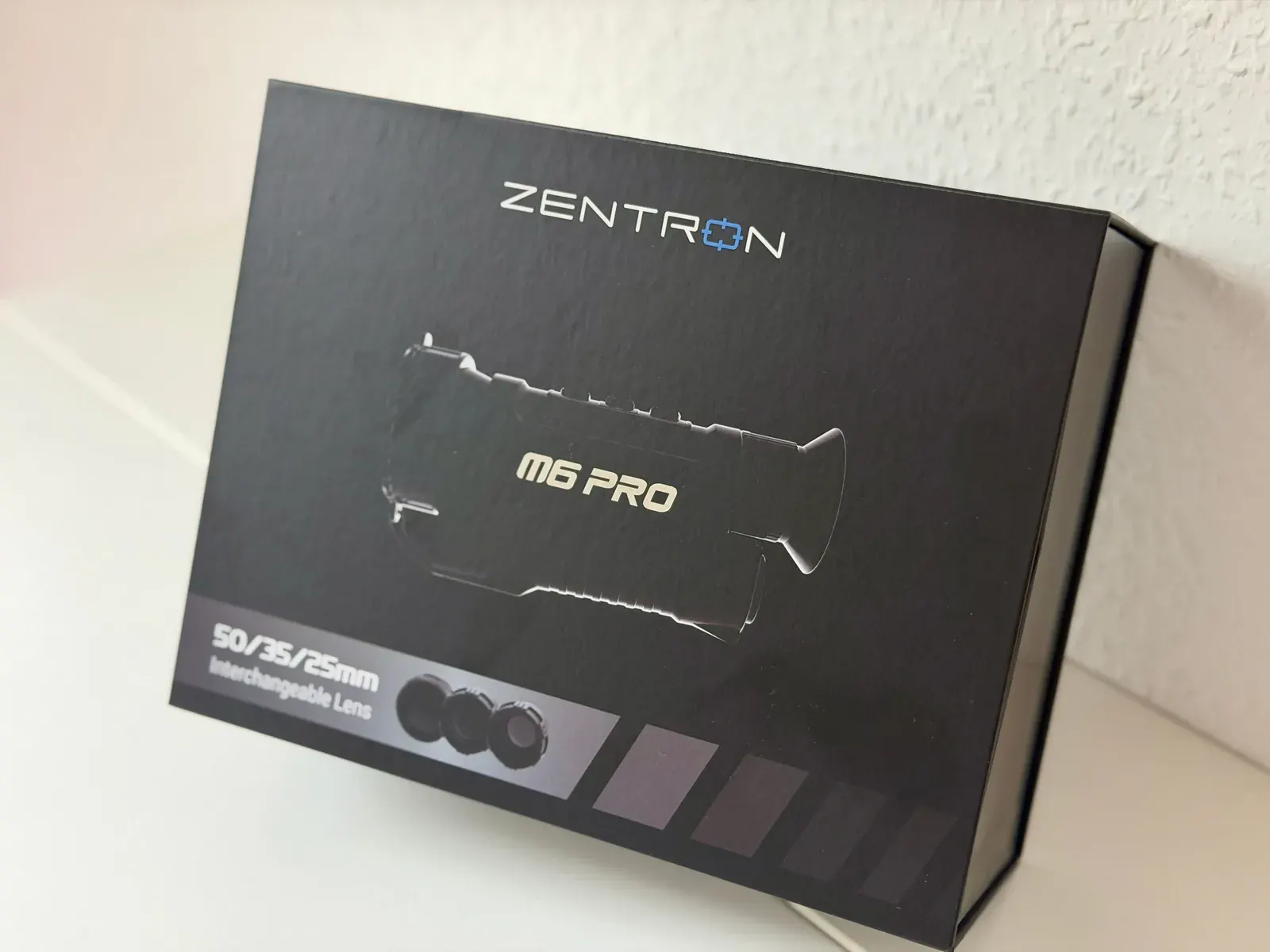
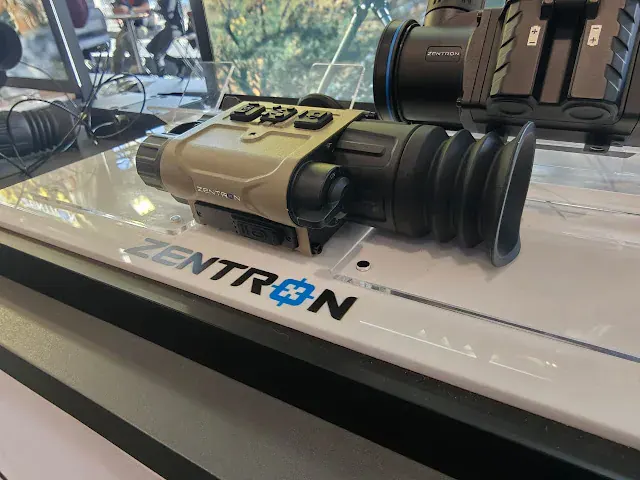
At this year’s IWA in Nuremberg, my route therefore also took me past the Zentron stand. The M6 Pro caught my eye fairly quickly. The M6 Pro is a thermal imaging monocular with interchangeable lenses and an integrated laser rangefinder.
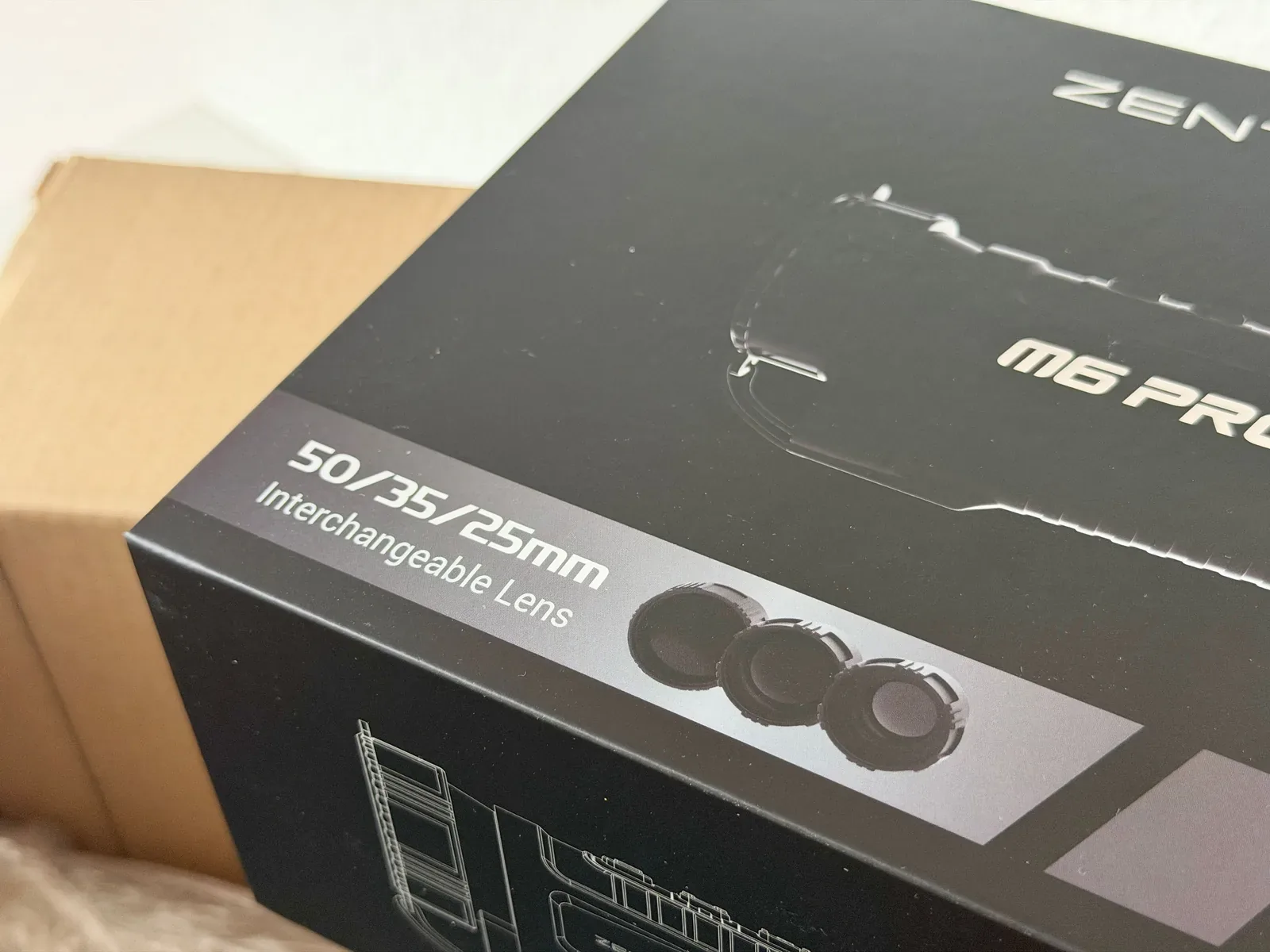
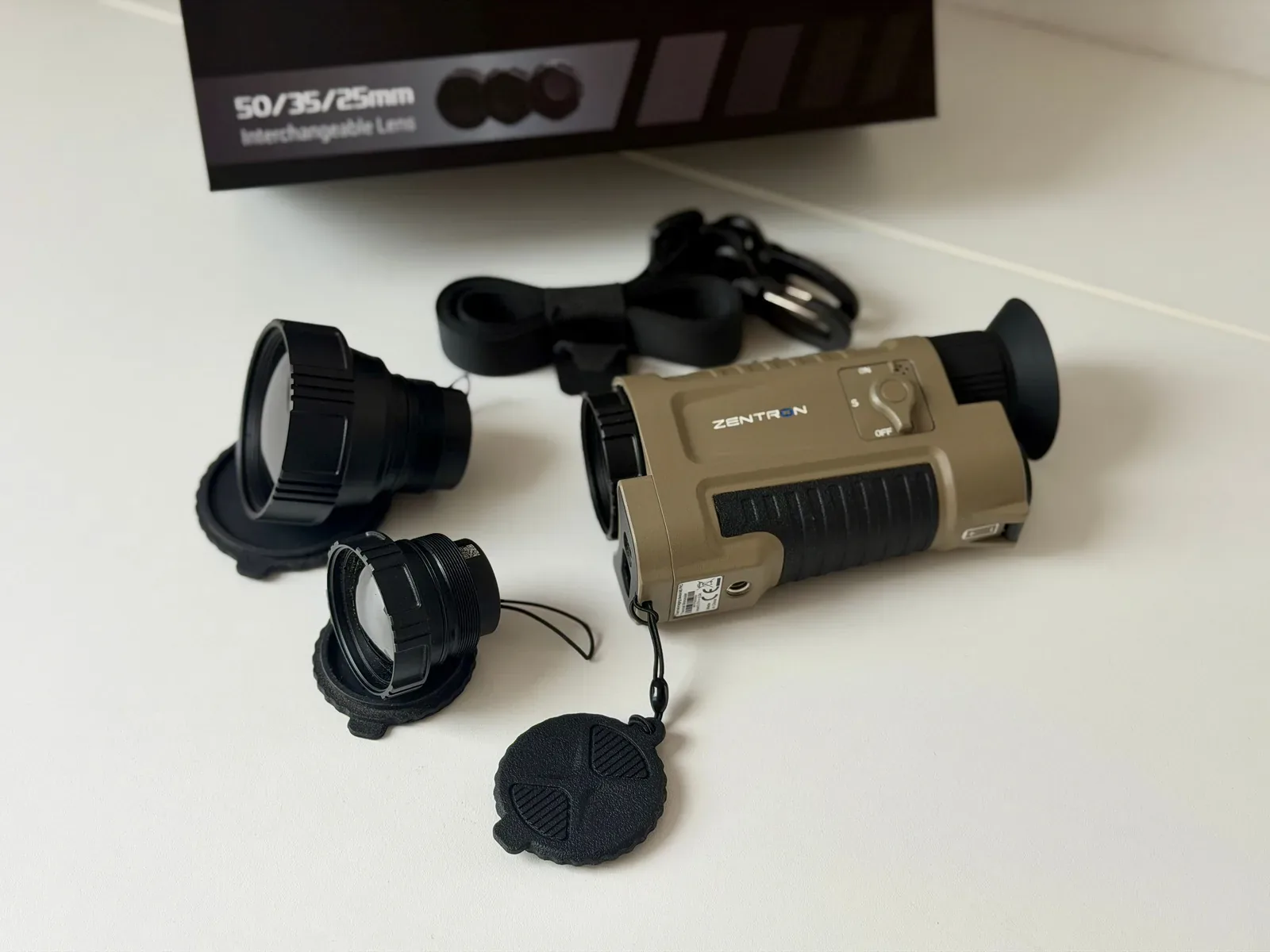
But thermal imaging monoculars with interchangeable lenses have been around for ages! Yes, that is basically true. Anyone thinking, for example, of the Pulsar Telos range would not be wrong. However, on those devices you cannot simply change the lens yourself on the spot. For the conversion, you have to send the unit to the manufacturer or an appropriate service point. So quickly swapping the lens shortly before a high-seat session because conditions are different today, or because a spontaneous hunting invitation has come up, is not possible. Other thermal imagers, such as the InfiRay Zoom or the ThermTec Wild 650D, take a different approach with their dual-lens systems. Different focal lengths are available directly in the device, but this design also naturally brings larger dimensions and added weight. And that is exactly where the Zentron M6 Pro became interesting to me: a compact handheld unit with an integrated laser rangefinder that fits easily into a trouser pocket, has a 640 sensor, and at the same time comes with interchangeable 25, 35, and 50 mm lenses was, at least for me, something new.
And as is always the case with interesting new hunting toys: simply looking at them is somehow unsatisfying. So I asked on the spot whether I could test the M6 Pro extensively under real hunting conditions. After all, a test unit is by far the cheaper way to put new hunting gear through its paces, and as we all know, that benefits not only the bank balance but, as a result, domestic harmony as well. Happily, the request was approved straight away, and only a short time later I had the M6 Pro with me for a thorough getting-to-know-you period. My test unit came in the TAN version, i.e., sand-colored. Anyone who prefers a more classic and discreet look can choose the black version instead. Technically, of course, there is no difference between the two versions.
It was therefore time to find out whether the interesting concept could also prove itself out in the hunting ground. In my leased hunting ground in particular, the requirements change significantly over the course of the hunting year. In winter I spend a lot of time out on the meadows and like to stalk there with as wide a field of view as possible, so a 25 mm lens suits me best. In summer, by contrast, hunting increasingly shifts to the fields. Distances become greater, and I therefore much prefer to reach for a 35 or even 50 mm focal length. Rather than keeping several devices for this purpose (I currently use a HIKMICRO FQ25 in combination with a Habrok HQ35L), I found the idea quite charming to get by with only one handheld device in the future and equip it with the right lens depending on the territory, season and hunting situation.
Technical Details
The M6 Pro has the following key specifications:
- Sensor: 640x512
- Lens: 25, 35 & 50mm (F1.0)
- 25mm: 1.4x magnification, 35mm: 1.9x magnification & 50mm: 2.1x magnification
- Pixel pitch: 12μm
- ·Frame rate: 50Hz
- OLED display in 1920x1080
- NETD: ≤18mk
- Laser rangefinder up to 1,200m
- IP67 protection
- Battery: 1x 18650 (approx. 7 hours runtime)
- USB-C interface
- Weight: 330 to 370 grams, depending on lens choice
The technical data quickly show that Zentron is positioning the M6 Pro in the premium class of thermal imaging monoculars. I particularly like the option of using standard 18650 batteries, which provides a significant extra degree of flexibility in everyday hunting use. At just 330 grams including the 25 mm lens, the M6 Pro is also certainly one of the lighter representatives of its class. That is at least one point you quickly learn to appreciate on longer stalks.
Scope of Delivery
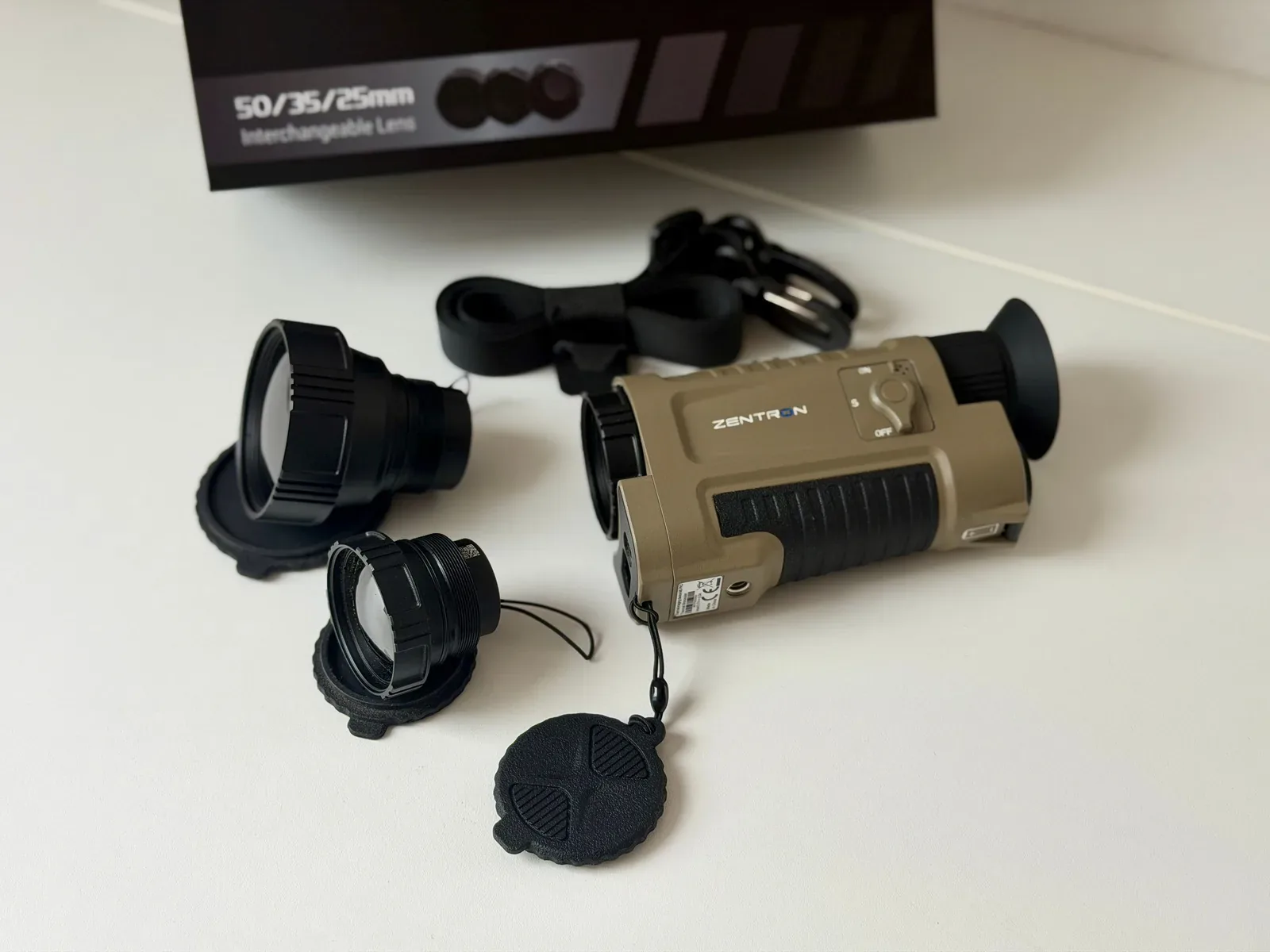
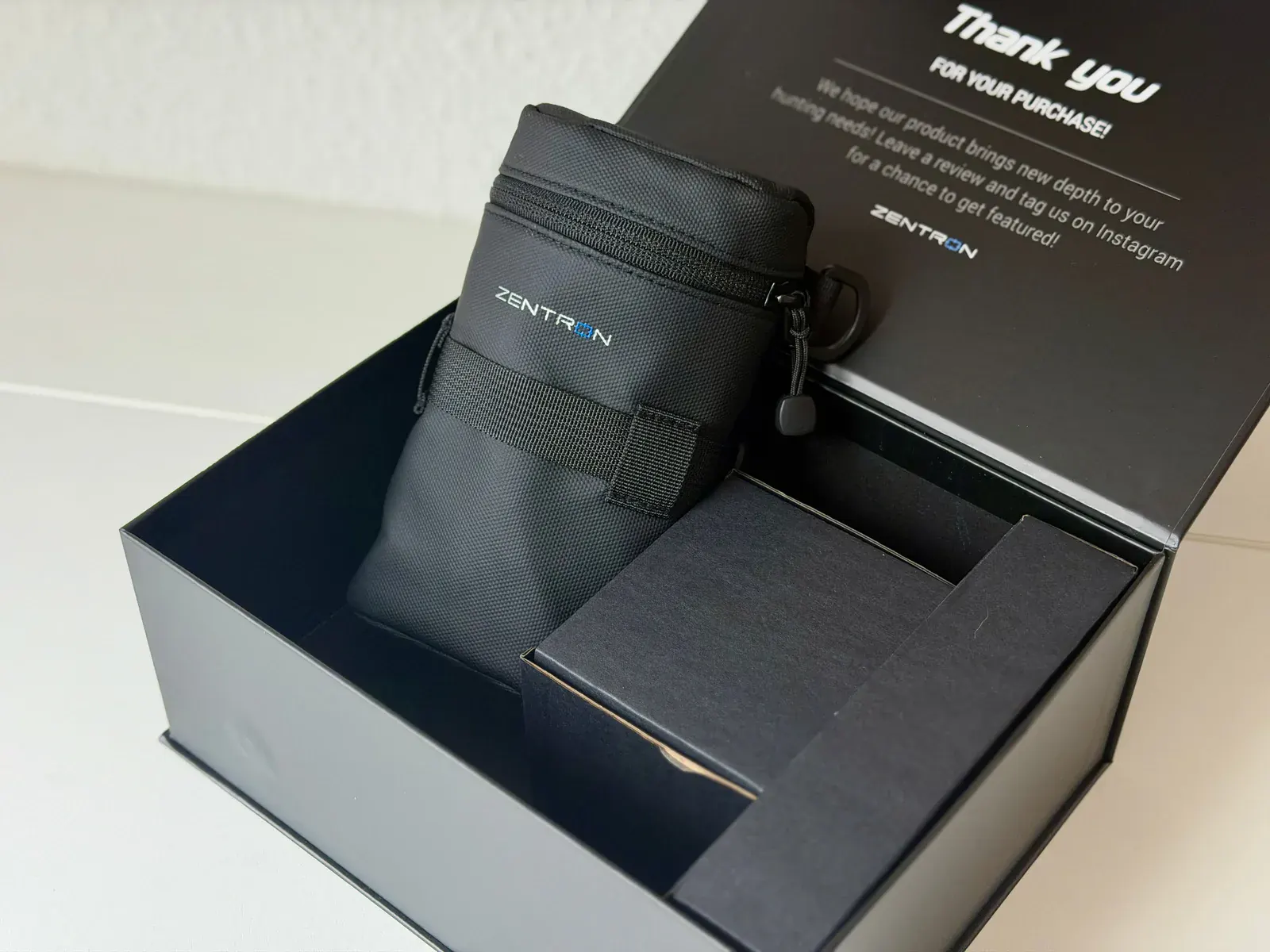
At first, the M6 Pro arrives in rather unspectacular fashion. Instead of elaborate packaging, you get a simple cardboard box containing the thermal imaging monocular. The three interchangeable lenses are packed separately and well protected in another cardboard package. The package also includes a USB-C charging cable, two 18650 batteries, and a suitable carrying case with a shoulder strap. I especially like that the case also has a MOLLE attachment. Someone actually thought this through! Wow! This means the M6 Pro can be carried conventionally on the strap, and the case can also be easily attached to other equipment. In my case, it fitted excellently onto my Vorn backpack.
A printed instruction manual was not included, at least with my test unit. In fairness, however, it cannot be ruled out that this was simply because it was a test device rather than regular retail stock. Although I personally usually manage perfectly well without instructions for devices like these, I know from older fellow hunters that a traditional printed manual is still very much appreciated.
Build Quality
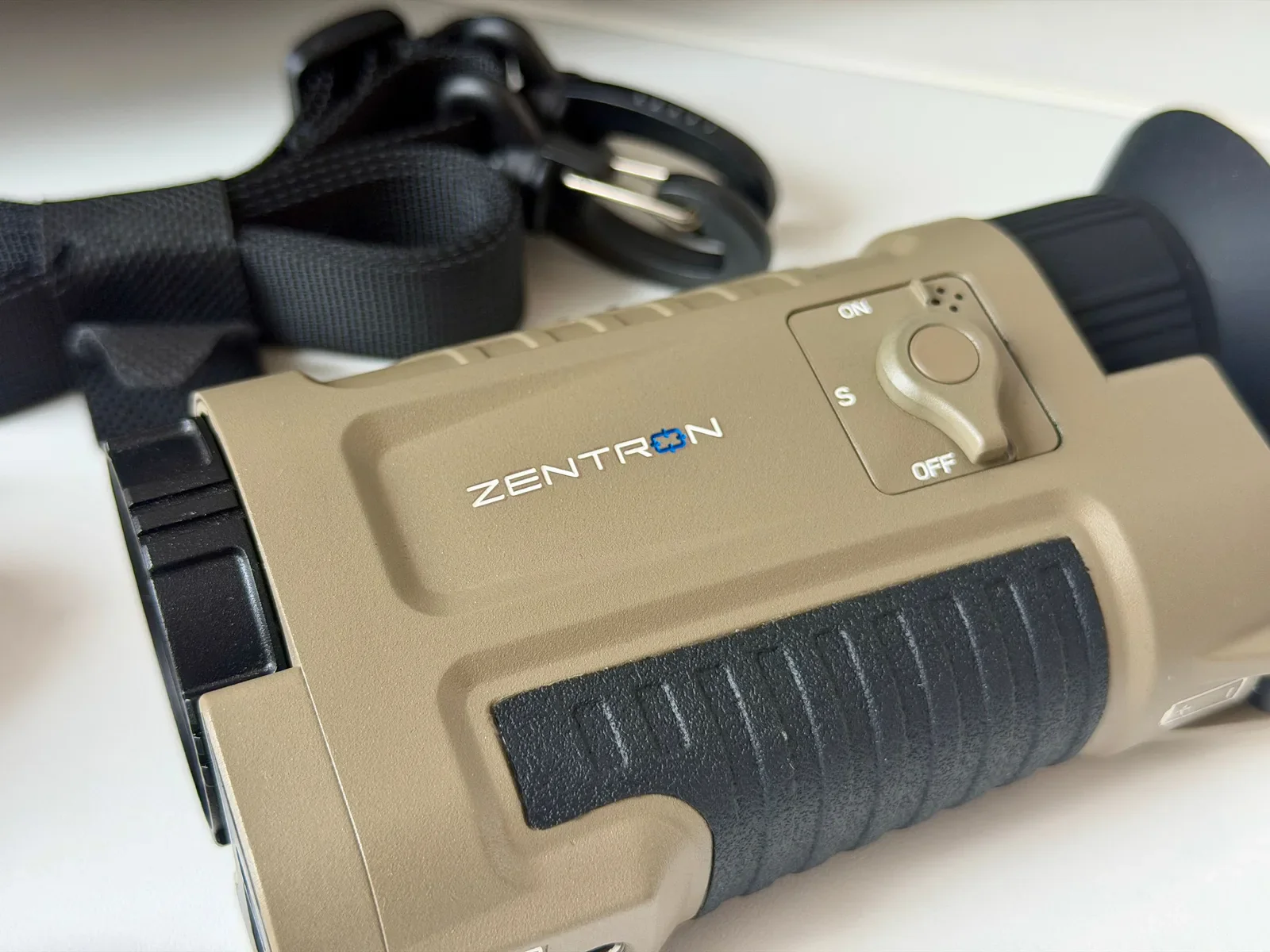
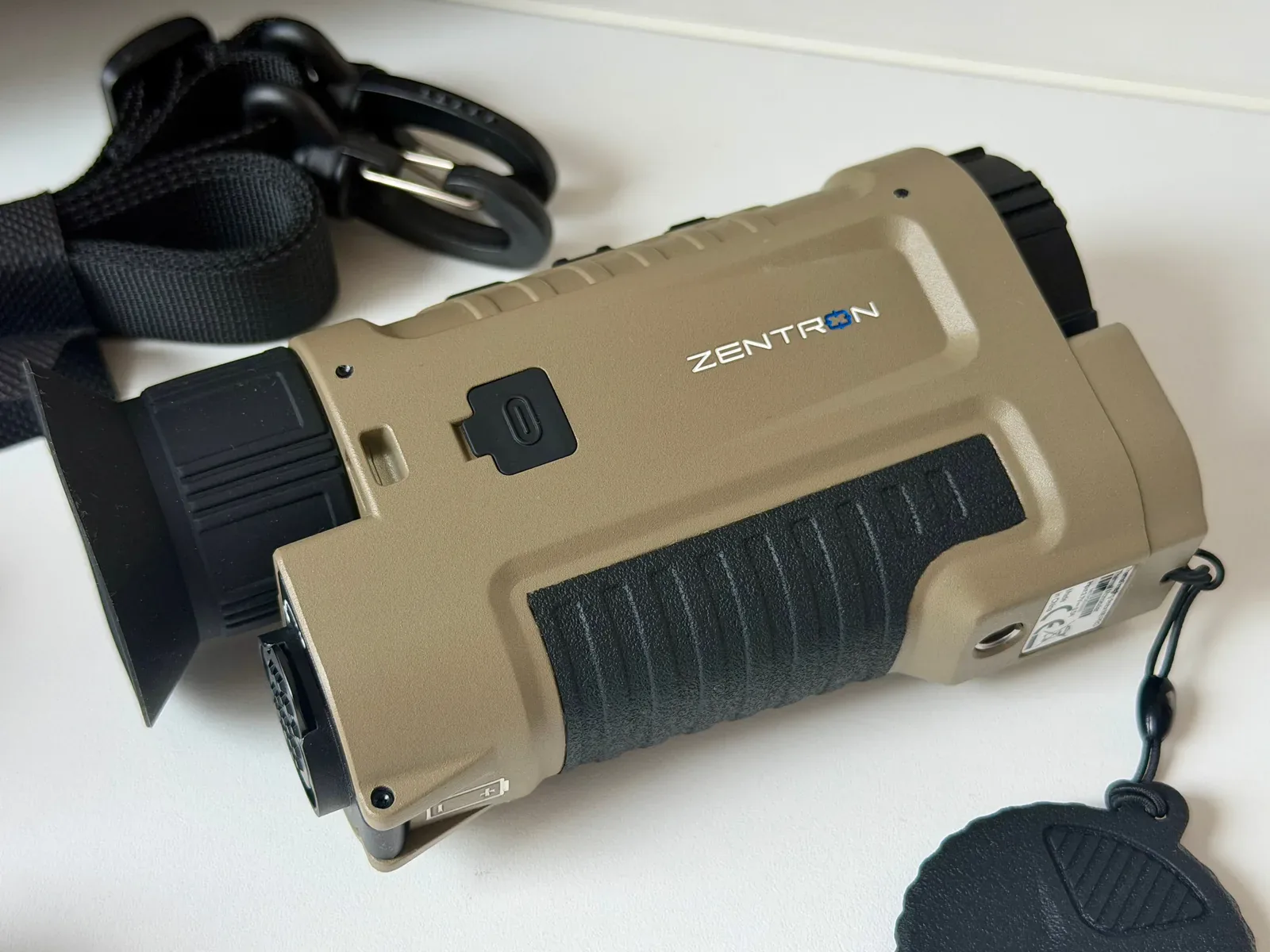
The M6 Pro's build quality is very good and immediately reminds me of the ZEN C50 I tested at the time. Here too, Zentron is clearly operating in the premium class. The housing is made of magnesium;; nothing rattles or feels cheap, and all controls convey a high-quality, robust impression. The lens cap is held magnetically against the housing and therefore stays neatly in place when open. A small but genuinely practical solution in everyday hunting use, as it prevents the cap from dangling around unnecessarily while stalking or observing. I already knew and appreciated this principle from my Pulsar thermal imagers, and it's a good, uncomplicated solution.
I particularly like the toggle switch with its three clearly defined positions: Off, Standby, and On. You can find and operate it easily, even in complete darkness. In general, I am a big fan of tactile feedback. When stalking in particular, I want to know my device's operating state without first looking at the display. By contrast, I am rather reluctant to rely on automatic standby functions. Anyone who sees it differently does not have to go without one on the M6 Pro, though. A so-called “Auto Sleep Mode” can also be activated in the settings to handle this task automatically if desired.
Adjust image focus the traditional way using the focus ring on the lens. It operates smoothly and lets you adjust the image quickly and precisely to the relevant observation distance. It works simply and flawlessly.
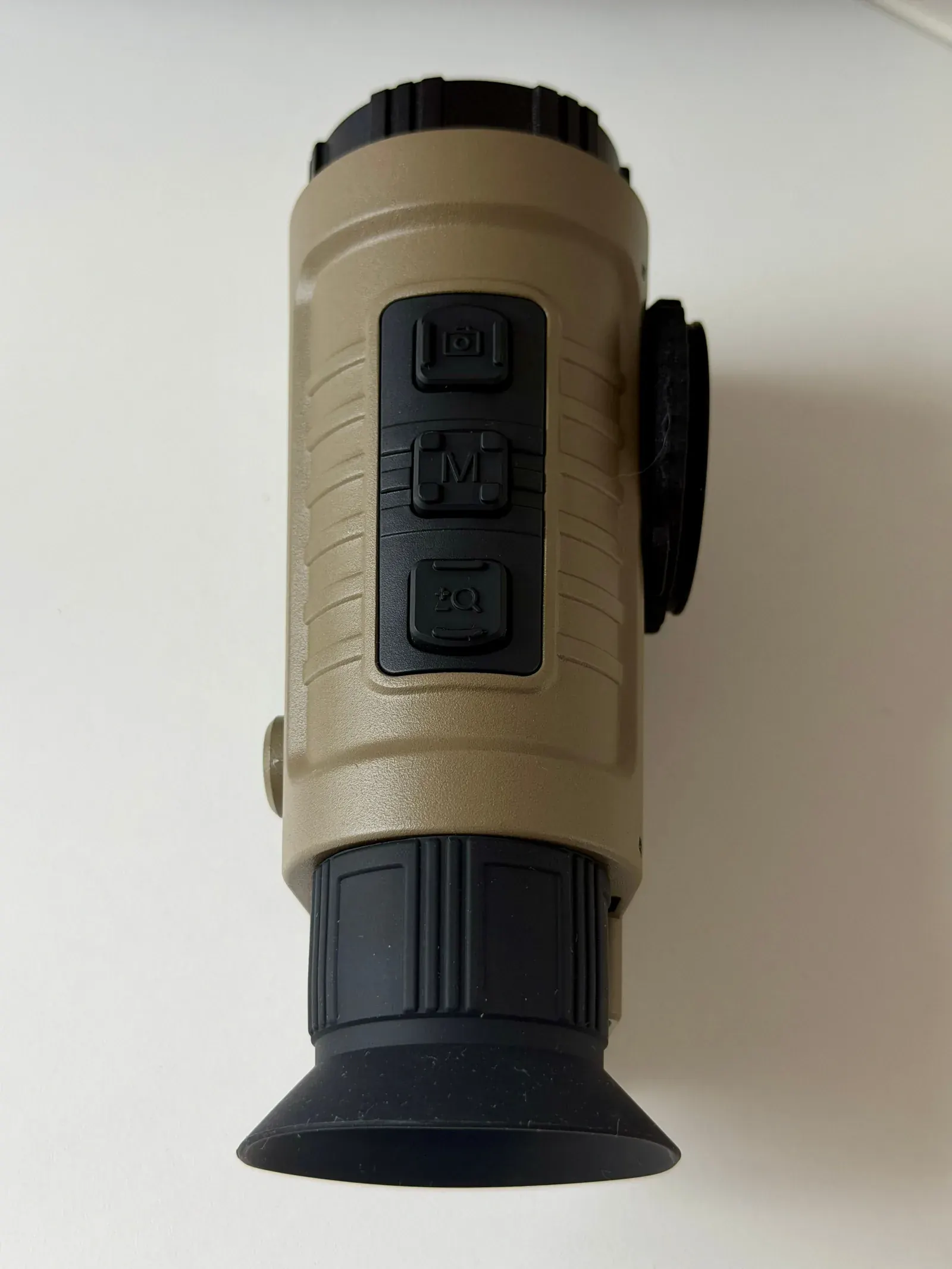
There are three clearly arranged control buttons on the top of the M6 Pro:
- Camera Button = Short press = screenshot; long press = video recording
- M = Opens the settings menu when held down
- Laser Rangefinding / Zoom = Short press = laser rangefinding; long press = digital zoom
The control buttons are clearly distinguishable by touch and can be located and operated without difficulty even in the dark or while wearing gloves. In actual hunting use, I like this much better than having a large number of similarly shaped buttons where you first have to work out where your finger has landed.
In addition to the now-practically-obligatory USB-C interface, the M6 Pro also features an integrated laser rangefinder. This feature is now common on many thermal imaging monoculars and, for me personally, has almost become standard equipment. Distances can be notoriously deceptive in the dark, which is why I greatly appreciate being able to obtain certainty at the press of a button. Especially when identifying and assessing game, the rangefinder is therefore a feature I would be very reluctant to do without.
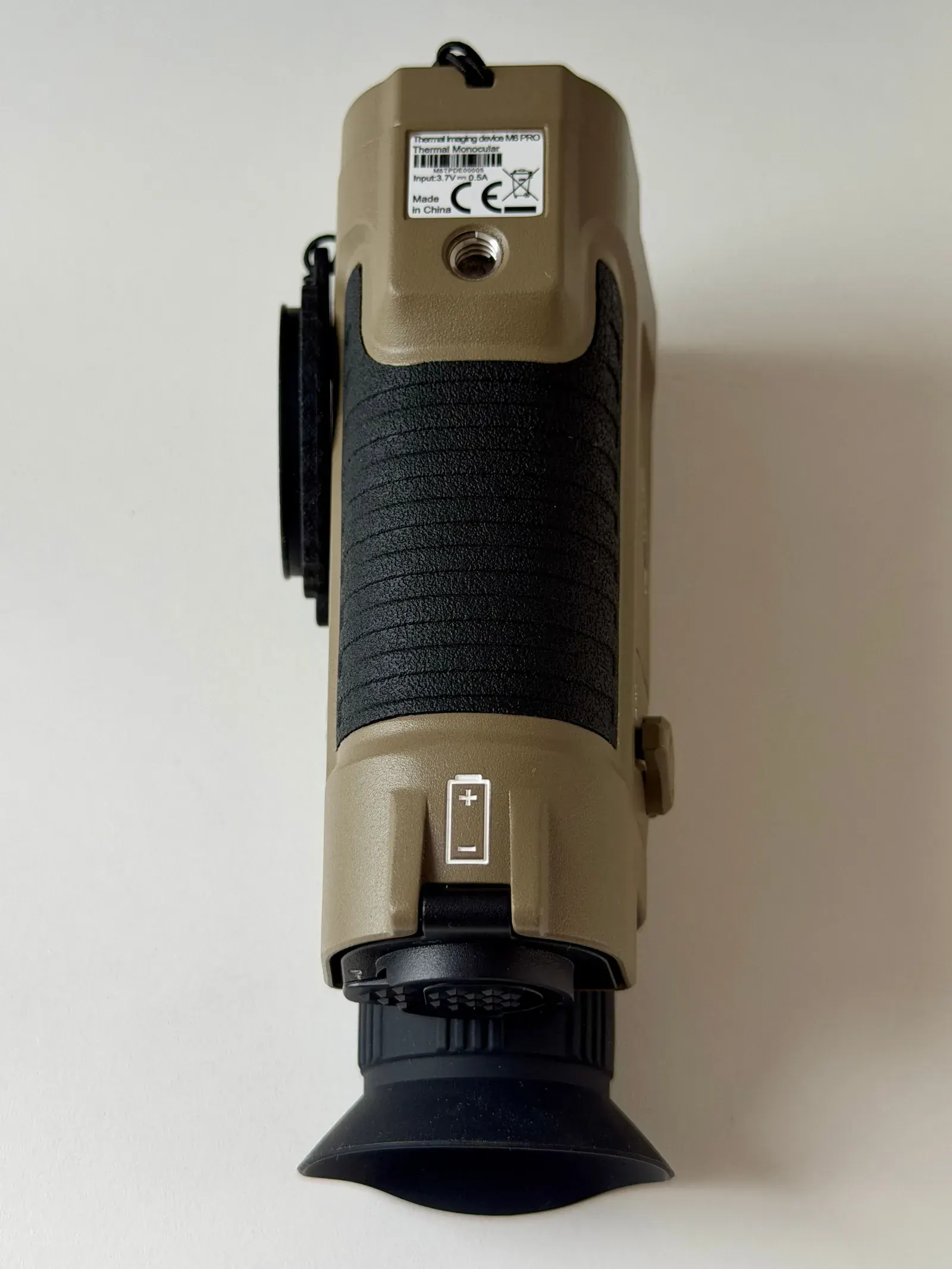
The M6 Pro has the obligatory 1/4-inch threaded mount on the underside. You can use it, for example, to attach suitable carrying straps or other accessories: nothing particularly special, but a practical standard feature.
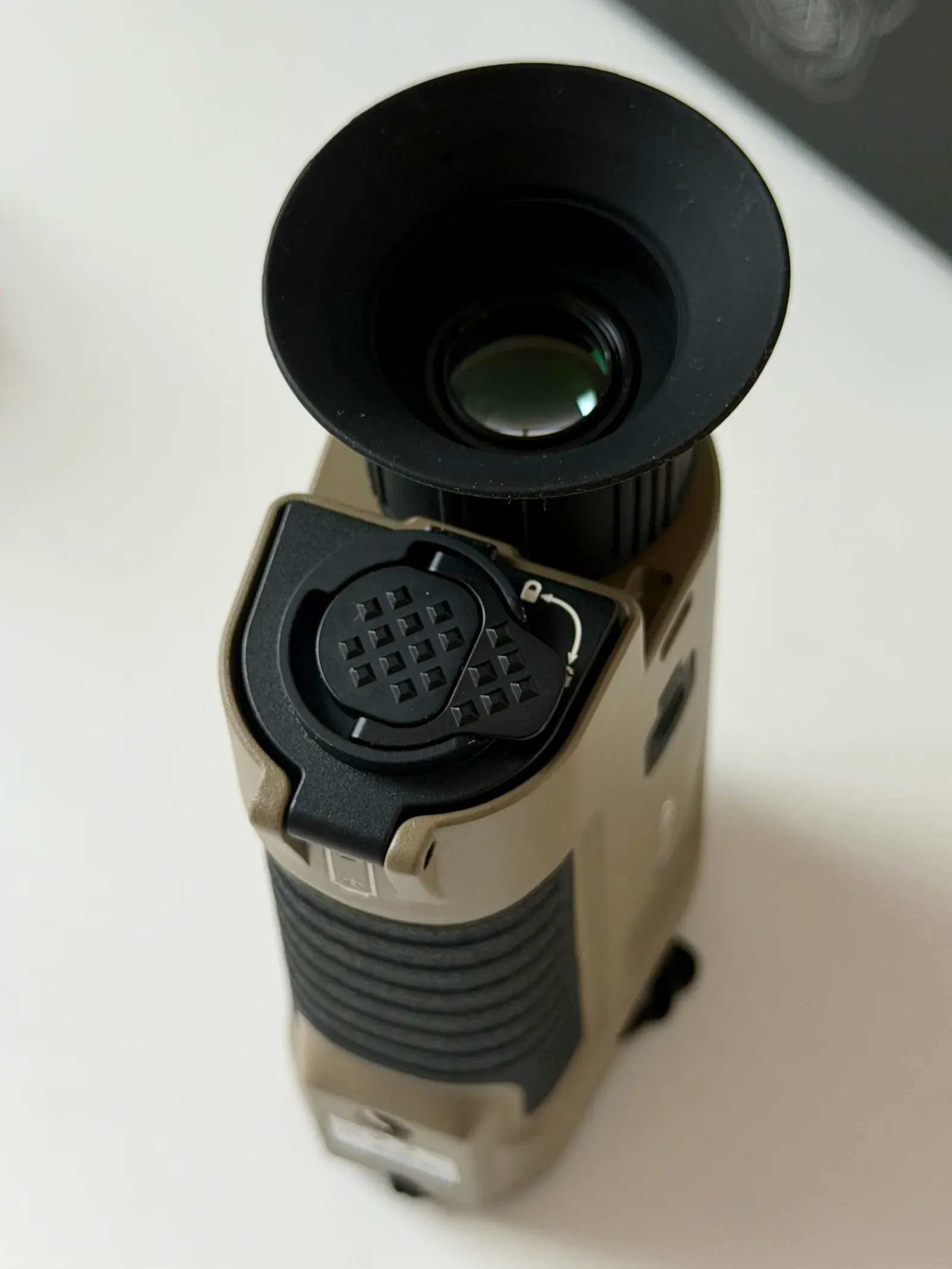
The 18650 battery sits behind a lockable battery cap that opens in just a few simple steps. The correct polarity is engraved directly on the housing, and the M6 Pro additionally features reverse-polarity protection. Accidentally inserting the battery the wrong way around should therefore not cause a problem. Particularly important to me: changing the battery also works without difficulty in the dark. You twist the locking mechanism open on the housing, remove the old battery, and slide in the new one. Then close and lock the cap again. Done! You can do most of the process “blind,” without first having to juggle a flashlight between your teeth.
Changing the Lens
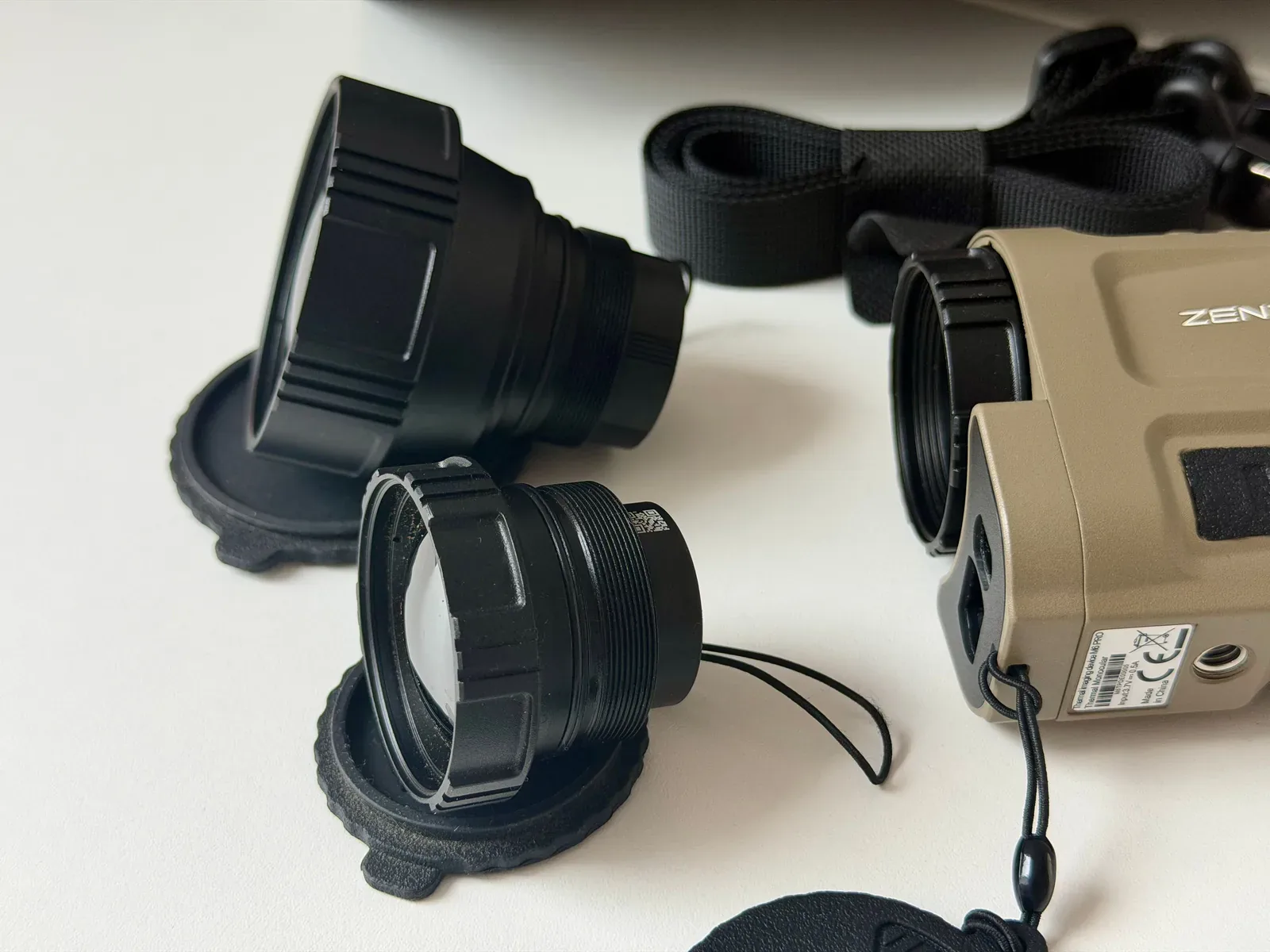
Now we come to the central topic and, for me, the M6 Pro's standout feature: how does changing the lens work in practice? The short answer: it is so simple that the change is done faster than I can write these lines. Thankfully, no tools are required. The lens currently fitted is simply unscrewed (which takes a little while), and the desired lens is screwed in instead, comparable to changing a lens on a DSLR camera.
A little care should of course still be taken when changing lenses. I would not necessarily perform the change out in the hunting ground with dirty or even bloody hands. On the other hand, you do not need clean-room conditions either. I had already discussed precisely this point with the staff at the Zentron stand at IWA. The M6 Pro sensor is additionally protected or coated and, if necessary, should be cleaned carefully with a suitable spectacle-cleaning cloth. The same applies to the interchangeable lenses. So there is no need to handle the lens change with kid gloves, although sensible care when dealing with optics should go without saying. In practice, I handled it slightly differently anyway. Before heading out for a high-seat session or a stalk, I selected the appropriate focal length according to the conditions in the hunting ground and changed the lens at my desk at home. The time required? Less than 60 seconds.
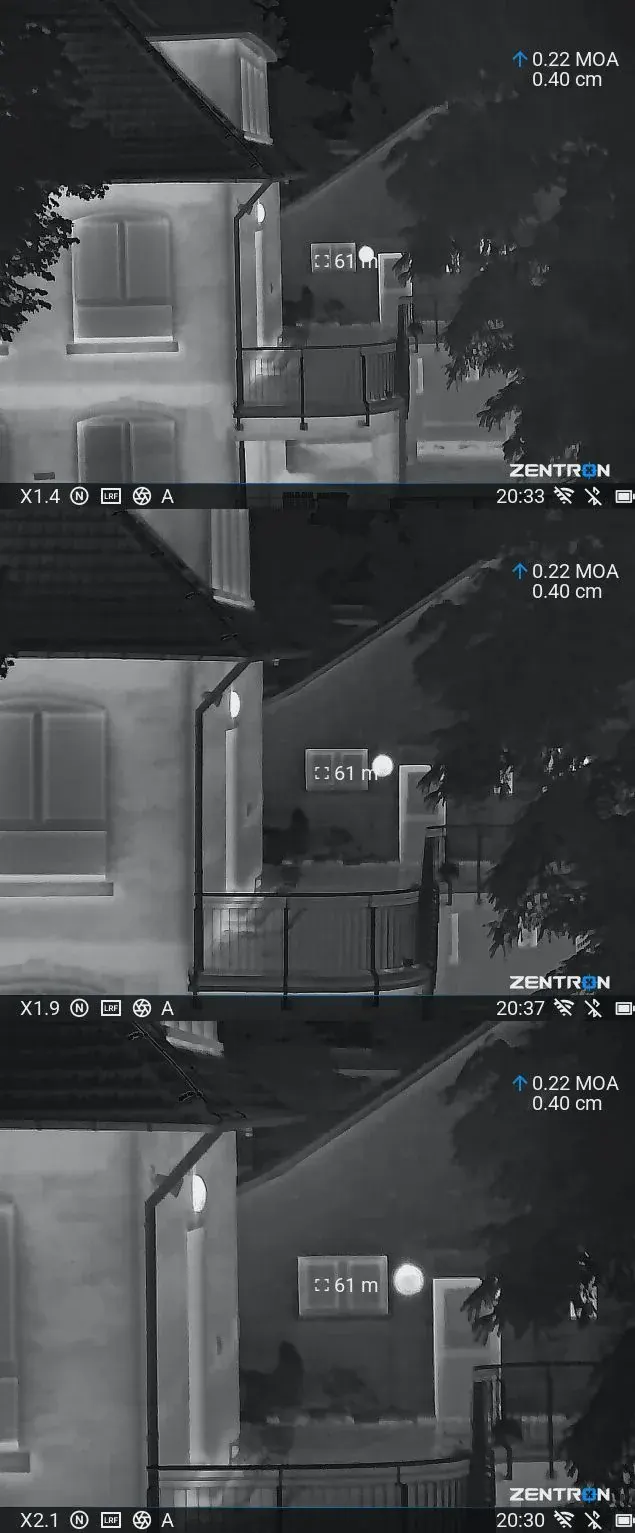
Changing lenses also changes the M6 Pro's base magnification: 25 mm is 1.4x, 35 mm is 1.9x, and 50 mm is 2.1x.
Image Quality
The M6 Pro's image quality impressed me during testing and remains very good even in adverse conditions such as rain or fog. As a direct reference, I compared it with my two HIKMICRO devices, which are also equipped with 640 sensors. In direct comparison, the Zentron has absolutely no need to hide from the established major players.
Differences only really became apparent in more difficult weather conditions, and even then they were fairly minor. Depending on the weather, sometimes the Zentron had a slight edge; sometimes one of the HIKMICRO devices did. I could not identify a clear winner here. To me, that is a good sign because, ultimately, it shows the level at which the M6 Pro operates in terms of image rendering.
The selection of color palettes is pleasingly large. Conveniently, personal favorites can be defined in the menu, so in everyday hunting use you do not have to click through every single option each time. Since I use White Hot and Black Hot almost exclusively anyway, these were also by far the most frequently used color palettes during my test. I did, however, find the also-available Cold Green mode interesting. Especially during longer observation sessions at night, I subjectively found the greenish display pleasant and comparatively easy on the eyes.
All three lenses made reliable identification of game possible, though each focal length naturally plays to its strengths in different situations. At greater distances, the 50 mm lens offers clear advantages over the 25 mm version, as expected—conversely, the 25 mm scores with its wide field of view at shorter distances. I find the 25 mm lens particularly practical for so-called “rubber stalking” (however controversial this form of checking the hunting ground may sometimes be). In my hunting ground, for example, it is useful for quickly getting an overview of the adjoining fields from the main road. Here, the 25 mm lens makes full use of its wide field of view.
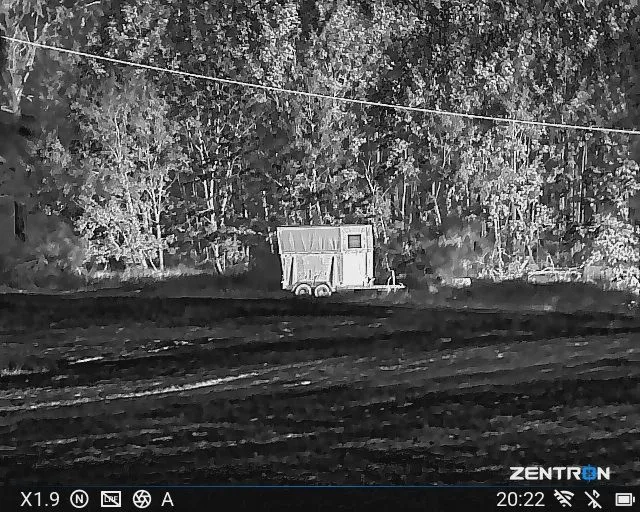
Below are a few more impressions recorded under normal weather conditions. It should be borne in mind that the recordings can only reproduce the actual display to a limited extent.
Viewed directly through the device, the image looks somewhat better again than it does in the saved photos or videos.
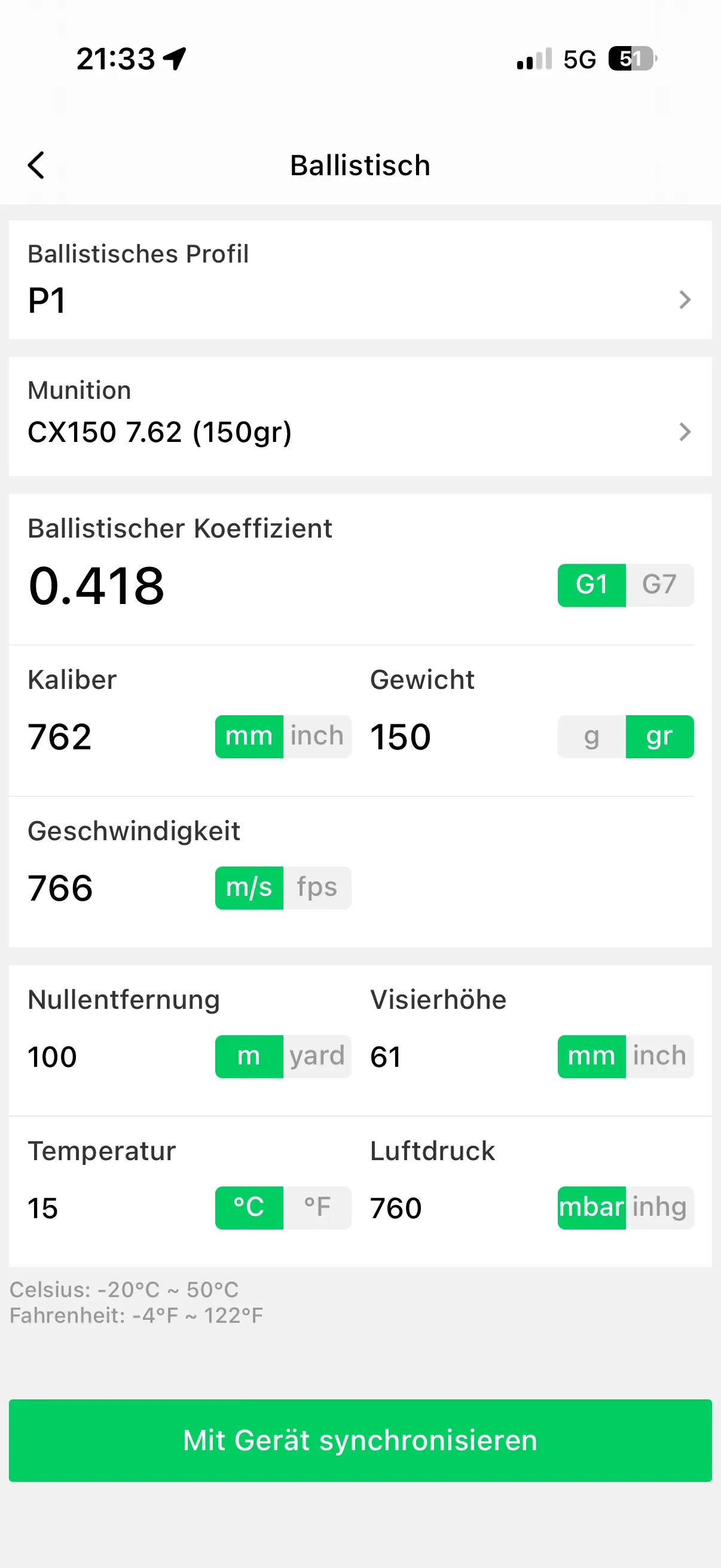
It also includes an integrated ballistic calculator. Once you enter the relevant ammunition and ballistic data (in my case, data for my own hand-loaded ammunition), the M6 Pro displays the calculated bullet deviation immediately after rangefinding, in both MOA and centimeters. This is clear in the embedded videos. Incidentally, this is extremely useful in practice. Bullet trajectory matters not only at long range: at very short distances in particular, the point of impact can be considerably lower with a rifle zeroed at 100 meters. And anyone who stalks at night knows that, in the heat of the moment, it is entirely possible to misjudge both distance and hold point. More than one tracking-dog handler could probably tell a story or two about that.
I therefore accept the frequently heard argument, “I don’t need something like that; after all, I know my hunting ground,” only to a limited extent. Everyone has probably heard that line, usually shortly before an estimated 80 meters suddenly turns out to be only 30. Especially at supposedly easy, short distances, the eye can be surprisingly generous with its estimates at night. If the M6 Pro is measuring the distance by laser anyway and then immediately provides me with the appropriate ballistic correction, I am happy to accept this little mathematics refresher. Better for the device to calculate once too often than for the tracking-dog handler later to explain where you should actually have held.
Another practical feature is the device’s built-in media playback. Recorded photos and videos can be viewed and managed directly on the M6 Pro without first having to reach for a smartphone. I already know this feature from my HIKMICRO devices and have come to appreciate it greatly there. Especially out in the hunting ground, I find it extremely practical to be able to review a recording immediately and check an observed situation without first taking the smartphone out of my pocket and establishing a connection to the device.
The M6 Pro can be connected to the ZEN LINK app via its integrated Wi-Fi interface. During my test, the connection worked quickly and reliably. Among other things, the app provides a live-view function, and you can also transfer recorded photos and videos conveniently to your smartphone. Firmware updates can also be done easily this way.
Conclusion
All in all, the Zentron M6 Pro convinced me across the board. The very good build quality, convincing image quality, integrated laser rangefinder and, of course, above all, the concept of lenses that can be changed quickly and without tools combine to create an overall package that is simply enjoyable to use in practice. For me, the real highlight of the M6 Pro is precisely the ability to cover three different focal lengths—25, 35 and 50 mm—with a single handheld device.
There is also little to complain about in terms of value for money. Or, to put it somewhat less elegantly: you get a lot of “Bang for the Buck” here. And that is great! If I did not already own my two HIKMICRO devices, I would know pretty much exactly which thermal imager would be sitting in my shopping cart right now. As things stand, however, it becomes difficult to give my wife a convincing justification for the new purchase, especially once the financial loss from selling the existing “old devices” is factored into the equation. Sometimes it is not the technology that stands in the way of wanting something, but the domestic financial controller.
Another positive point worth mentioning is the total warranty period of 3.5 years. Zentron provides a standard three-year warranty on the M6 Pro, which can be extended by a further six months by registering the device. Particularly with a technically sophisticated and not exactly inexpensive thermal imaging device, I consider such a warranty period a noteworthy advantage.
Anyone familiar with my previous test reports also knows, however, that I do not declare everything golden just because a test device has been provided to me. My reports are not “coordinated,” and if something strikes me negatively, I write that as well. That is probably due to my main profession, which fortunately may continue to remain incognito at this point.
So: what is there to criticize about the M6 Pro? First, I would like to see a shutterless system, such as the one familiar from HIKMICRO’s current 3.0 devices. Unfortunately, the M6 Pro does not offer this. Anyone who expressly wants to hunt completely without the familiar calibration interruptions will therefore currently have to look at other devices. The second point of criticism concerns one-handed operation. Thanks to its compact dimensions, the M6 Pro can already be operated quite well with one hand for the most part. There is still room for improvement when it comes to focusing, however. Other manufacturers show that a thermal imaging device can be designed even more consistently for one-handed use, with a focus wheel positioned close to the diopter adjustment. Especially when stalking, when the second hand may be occupied with a shooting stick or something else, you quickly learn to appreciate such small details.
The M6 Pro nevertheless is and remains a compact, very well-made, and exceptionally versatile handheld thermal imaging device whose interchangeable-lens concept genuinely delivers real added value in practice. Zentron has put together one hell of an overall package here!